German automaker BMW Group is increasing the use of recycled materials across its value chain for its new generation of electrified vehicles (EVs). This week the company said it would cut carbon dioxide emissions by at least 60 million tons by 2035as It is working to achieve net zero by 2050.
The aim is to reduce total CO2 Footprint per vehicle over the entire life cycle, as the group actively promotes decarbonization in the supply chain, which it believes is the most important lever for CO reduction2 Emissions, in addition to the usage phase.
“The key measures to achieve these results include the increasing use of renewable energies in production and the supply chain, the increased use of secondary raw materials, increases in efficiency in the use phase as well as product and process innovations. The latter are being implemented across all drive variants as part of the BMW Group's technological openness. In addition, an increasing proportion of the vehicle fleet will continue to be electrified,” it said in a statement.
The maker of the X5 and X3 cars is building an ecosystem that promotes sustainability, minimizes waste and reuses waste material to create a circular economy. BMW believes that the circular economy will play a key role in further reducing CO2 emissions.
The company has a global network of around 2,700 direct suppliers – more than half of which have production sites in Germany. The aim is to establish Munich as a “Silicon Valley of the circular economy”.
Two years ago, BMW launched Circular Republic in collaboration with UnternehmerTUM, a center for innovation and business creation in Munich, to improve the circular economy and create a common platform for large and small circular initiatives. The partnership has resulted in numerous innovations from used materials. These include seat covers for the BMW iX3 50 xDrive electric vehicles, whose fabric, adhesive and fleece are all made of PET (polyethylene terephthalate). The textile yarn used is also made entirely from recycled PET.
In South Africa, the BMW plant in Rosslyn, Pretoria, has worked with various waste management organizations to “achieve zero waste on-site by ensuring that all excess materials and components are reused.”
Other components include the center console, the instrument panel and the interior floor panel.
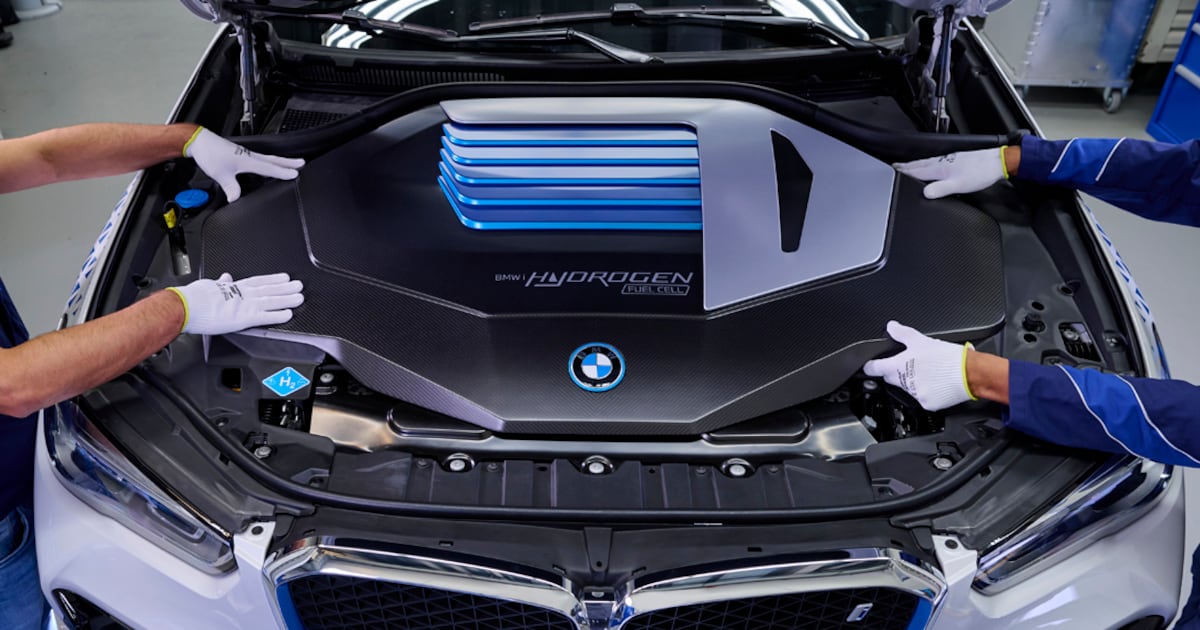
The BMW Group is also increasingly relying on the use of innovative and secondary materials for other components. It is said that 30% of the secondary raw material for the engine compartment cover and the storage compartment under the front lid is made from recycled maritime plastic.
Secondary aluminum makes up 80% of wheel carriers and pivot bearings and 70% of cast aluminum wheels. Secondary materials make up a third of all materials used in the new BMW iX3 50 xDrive, the first production model in the Neue Klasse.
BMW Group said the circular economy is a key focus of its strategy. “The use of secondary materials not only helps reduce our CO₂ emissions, but also offers economic advantages: it reduces geopolitical risks and makes us more independent of primary raw materials.”
The use of secondary material has been expanded to the battery plant for electric vehicles in Irlbach-Straßkirchen, Lower Bavaria, where the BMW Group is building one of six new assembly plants worldwide for sixth-generation high-voltage batteries. Once completed, the facility will produce 1,000 batteries per day that will be recyclable at the end of their life.
In South Africa, the BMW plant in Rosslyn, Pretoria, has worked with various waste management organizations to “achieve zero waste on-site by ensuring that all excess materials and components are reused.”
One of its partners is Envirolite – an eco-friendly construction supplier that has helped the car manufacturer convert some of its waste into sustainable and environmentally friendly building blocks. Envirolite bricks are made from 70% or more recycled material, including polystyrene waste generated at the facility.
Reflecting BMW Group South Africa's circular economy principles, 7,700 Envirolite bricks were used to build the logistics warehouse, which primarily stores various parts for the BMW X3 plug-in hybrid vehicle and ensures timely delivery of components to the assembly line for smooth production.